
THE TEARS OF NERAKHIS: THE MUSICAL
Music showcase
Introduction
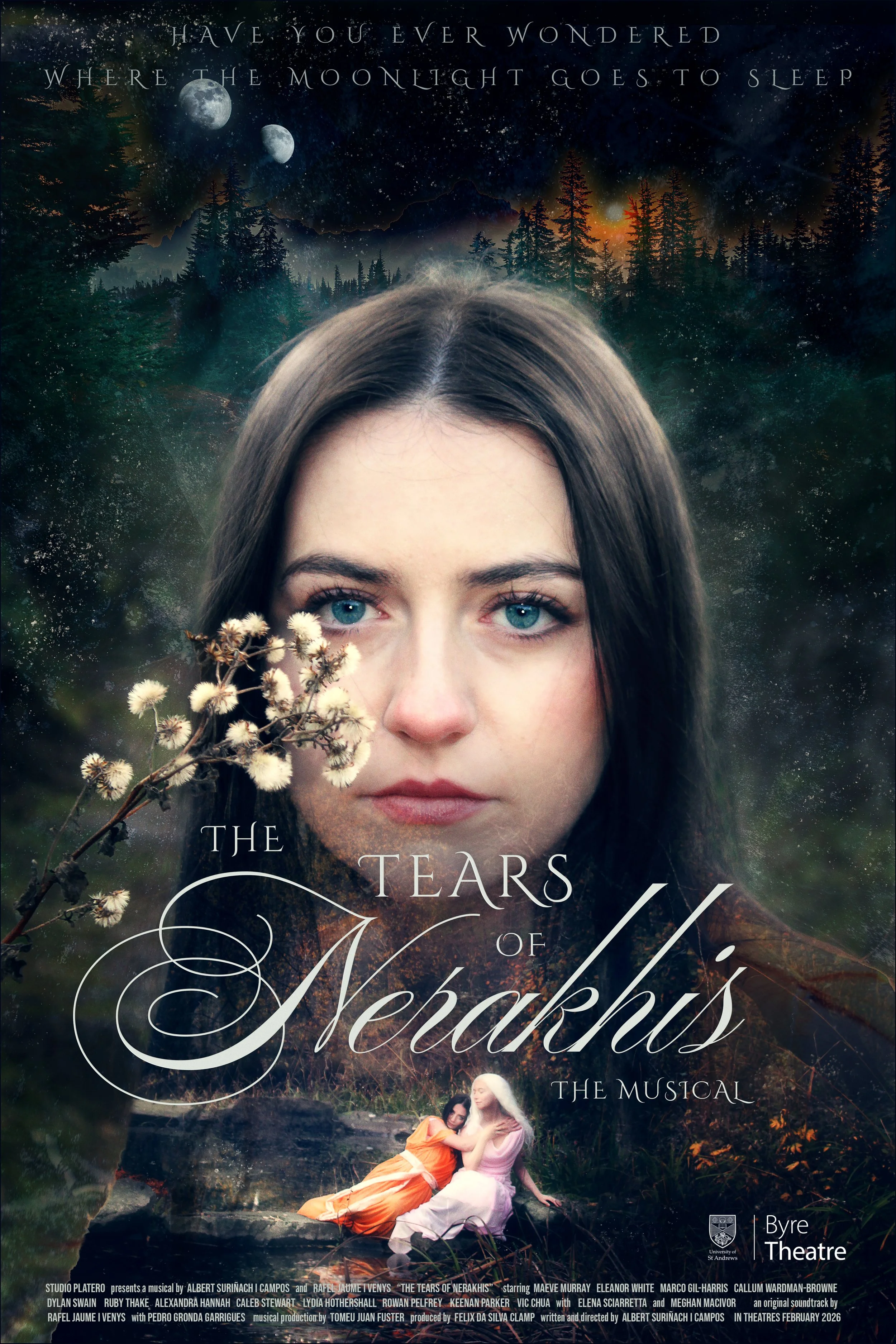
The Tears of Nerakhis is a musical created by Albert Suriñach and Rafel Jaume i Venys. The story originates from a fantasy novel written by Albert, published in Spanish in January 2025. The music and orchestration has been composed by Rafel, musician and philosopher, while the lyrics, in English, are written by Albert. The musical direction is led by Louie Scott.
The project began approximately two and a half years ago and, as it has grown, has involved the participation of over a hundred students from the University of St Andrews, where Albert is currently studying Classics. It has also received support and guidance from several prestigious Scottish arts institutions, including the Laidlaw Music Centre, the Byre Theatre, and the Royal Conservatoire of Scotland.
The musical premiered at The Byre Theatre on February 5th and 6th, 2026, with a total audience of 426 people. It is currently being performed in concert format, with an orchestra of 25 musicians, and is scheduled to run at the Edinburgh Fringe Festival in August 2026—one of the world’s most important theatre festivals—for six consecutive days with the original cast.
At the same time, all songs are being recorded with the cast for release as a full album. The singles “Calanthe of Many Flowers” and “Diamonds of Ice” are already available on all streaming platforms.
With 21 musical numbers and 15 recitatives, the work is fully sung through across its two-and-a-half-hour duration. On this page, we have selected a representative sample of songs to showcase the range of genres and styles present in the musical.
Thank you very much.
Albert, director of“The Tears of Nerakhis”
Calanthe of many flowers
“Calanthe of Many Flowers” is the musical’s most iconic song. Positioned in Act I, it establishes Calanthe as the protagonist and reveals her deepest desire: to abandon the world of men, which has brought her so much suffering, and transform into a tree, becoming part of the natural realm of Nerakhis.
Her invocation becomes the narrative driving force of the entire story. Musically, the orchestra unfolds in two dimensions: arpeggiated violins express her restlessness and longing for transformation, while descending brass lines suggest the distant and powerful perspective of the god.
You can access the vocal and orchestral score for “Calanthe of Many Flowers,” as well as the audio file with the orchestration, here:
Diamonds of Ice
“Diamonds of Ice” is the love song of the musical. When Calanthe arrives in the magical gardens of Nerakhis, the god of night, she meets his daughter, Alea, princess of nature. In the stillness of the gardens’ nights, the two fall in love and share this song.
Its delicate and evocative melodies resonate throughout the work as leitmotifs, reappearing across the musical and weaving an emotional thread that follows their story.
You can access the vocal and orchestral score for “Diamonds of Ice,” as well as the audio file with the orchestration, here:
The Greatest
“The Greatest” marks a radical shift in the musical. Until this point, classical and pastoral sonorities have dominated, tied to the bucolic gardens of Nerakhis and the love story between Alea and Calanthe. With this number, however, the protagonists leave this world behind and re-enter the realm of men, where they encounter the God of the Sun, a charismatic, magnetic, and deeply egocentric figure determined to use them for his own gain.
Inspired by son cubano, the piece combines festive energy with a growing epic scope, culminating in an apotheotic finale that brings Act I to a powerful close.
You can access the vocal and orchestral score for “The Greatest,” as well as the audio file with the orchestration, here:
The Sultan
Continuing with the lively, Latin-influenced musical language of the human world, Alea and Calanthe journey across it and eventually arrive at the Sultan’s court. There, his subjects become utterly enchanted by Alea, seducing her with wealth and attention. This creates a growing tension between the two protagonists, ultimately leading to their separation.
The number blends tango with elements of pasodoble, combining passion, drama, and strong theatrical energy.
This video also includes a recitative. Recitatives are shorter, lighter pieces that serve as transitions between the main musical numbers. While the work contains 21 principal songs, it also includes dozens of these recitatives, as the musical is entirely sung through. This excerpt has been included to illustrate the overall pacing and continuity of the piece.
You can access the vocal and orchestral score for “The Sultan,” as well as the audio file with the orchestration, here:
Min
After being abandoned, Calanthe mourns her fate and sets out on a solitary journey into a magical forest, where the two moons descend from the sky to restore the brightness of her gaze and instill in her the courage to go in search of Alea.
This piece is one of many ballads and solos that define Calanthe’s character, alongside “Calanthe of Many Flowers,” “A Thousand Faces,” and “Wolf of Ice,” all of which trace her emotional and spiritual evolution.
In the version shown in the video, the song is accompanied only by piano, enhancing its intimacy and fragility. A later arrangement for chamber orchestra has since been developed, expanding its timbral and expressive range.
You can access the vocal and orchestral score for “Min,” as well as the audio file with the orchestration, here:
The Fugo
This is the most comedic number in the musical. Fugo, the God of Time, is a comic character who appears as Calanthe wanders in search of Alea. With a playful and irreverent style, he recounts everything that has taken place in the world of men during her absence.
The piece is full of energy and humor, drawing on influences from pop, 1950s–60s American doo-wop, and artists such as Michel Sardou. It also features a saxophone solo that enhances its lively and playful character.
Much of the number’s strength lies in the performer’s dynamic and comedic versatility, as it allows for light improvisation and direct interaction with the audience. Here, this potential is brought to life brilliantly by our Fugo actor, Callum Wardman-Browne.
You can access the vocal and orchestral score for “the Fugo,” as well as the audio file with the orchestration, here:
The Tears of Nerakhis
This is the final musical number of the work. Alea has died, a victim of the envy and desire of men, and Calanthe is left completely alone.
One morning at dawn, as she steps outside, she notices drops of water on the grass and realizes that the dew is in fact the tears of Nerakhis, the god of night, mourning the loss of his daughter. This revelation transforms her grief into something greater, connecting human sorrow with the divine.
In this final moment, all the female characters who have been lost throughout the story return to form a final chorus: the song of the Tears of Nerakhis, which closes the musical with a collective, emotional, and transcendent dimension.
You can access the vocal and orchestral score for “The Tears of Nerakhis,” as well as the audio file with the orchestration, here:
Extra: the Wedding
As an appendix, we include a number that places less emphasis on musical impact in isolation and more on narrative progression: “The Wedding.” This piece portrays Calanthe’s forced marriage to her husband, a pivotal moment that precedes her escape and eventual arrival in the gardens of Nerakhis.
Far from being a simple introductory episode, the number functions as a musical synthesis of the first part of the work, weaving together several leitmotifs introduced in the opening quarter of the musical. This gives it strong internal coherence and reinforces its narrative value, which is why we have chosen to include it as a complementary piece.
Get in Touch
If you’d like to know more about this project, or help in any way, please get in contact with us. You can contact us at the email:
or the number +34 626502776
We also have a crowdfunder to be able to produce the cast recording and the concert and performances from the Fringe. Any donations will be veyr much appreciated and go a long way in allowing us to bring this musical to life.